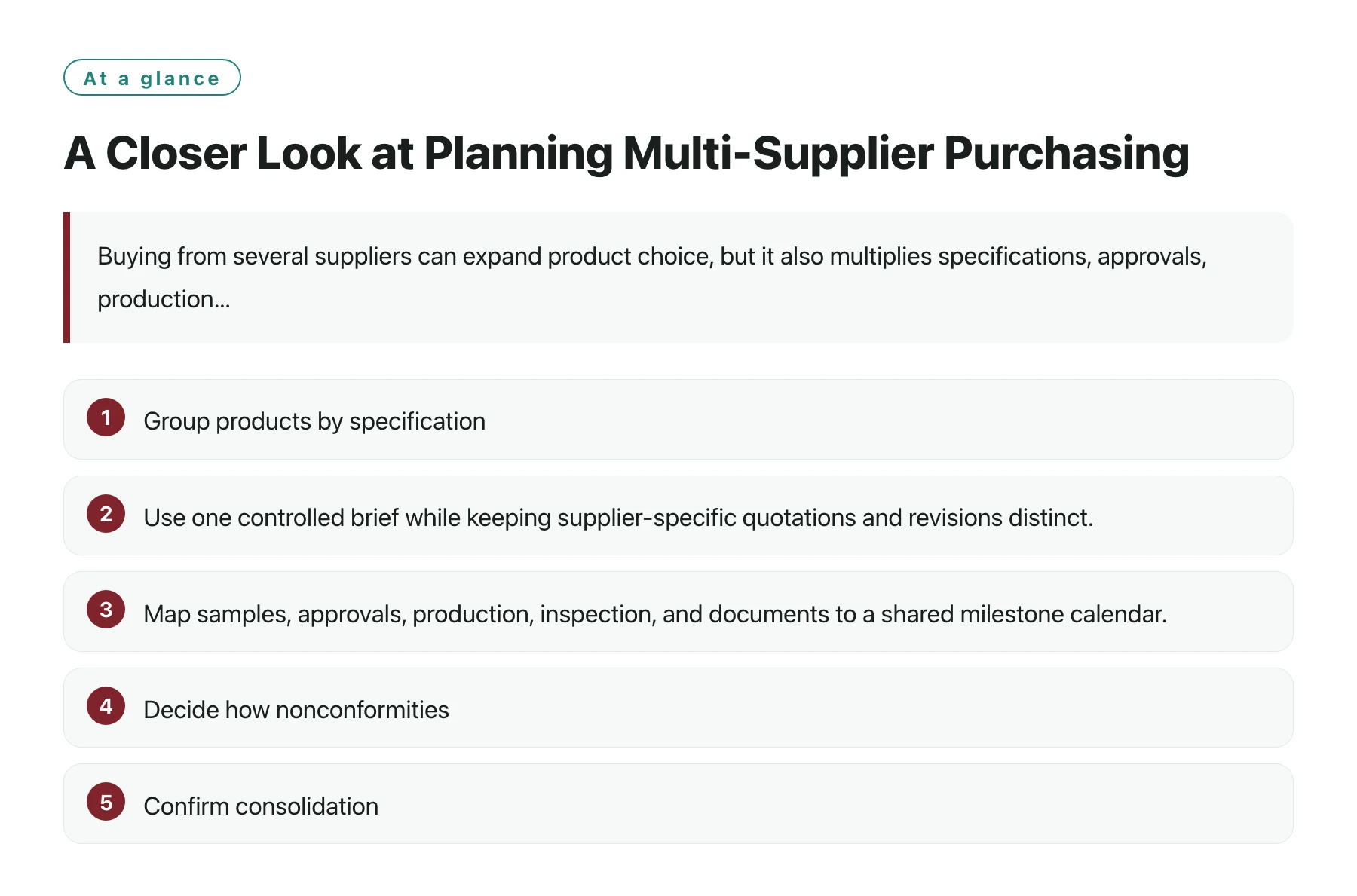
Buying from several suppliers can expand product choice, but it also multiplies specifications, approvals, production schedules, inspection decisions, and shipping handoffs. A workable plan assigns one owner to each decision, standardizes the information suppliers receive, tracks order-specific differences, and sets a common view of readiness and delivery. The aim is not to make every supplier identical; it is to make dependencies and responsibilities visible before they disrupt the project.
Key takeaways
- Group products by specification, production risk, supplier readiness, and delivery need.
- Use one controlled brief while keeping supplier-specific quotations and revisions distinct.
- Map samples, approvals, production, inspection, and documents to a shared milestone calendar.
- Decide how nonconformities, late orders, substitutions, and partial readiness will be handled.
- Confirm consolidation, delivery terms, costs, and shipment records with the responsible logistics parties.
A multi-supplier plan should show both the shared milestones and the differences that can affect each order.
Group demand before requesting quotations
List products, specifications, quantities, variants, required dates, and destination for the full purchase. Identify items that share materials, quality checks, packaging, or shipping needs and those that require separate handling. Grouping helps buyers see potential consolidation opportunities, but it should not obscure different technical requirements or make a supplier quote a product it cannot produce.
Decide whether products should be sourced by category, capability, risk, or existing supplier relationship. For each package, state whether a supplier may quote a subset or must quote the full scope. Require vendors to identify their production site and any subcontractors involved. A shared commercial request does not mean all items will come from one factory or follow the same control process.
A qualified JS Sourcing China sourcing agent may coordinate information among suppliers, but the buyer should define who owns specifications, supplier approval, payment, inspection, and shipment release. Record that responsibility map before orders are placed so a production question does not sit unanswered between teams.
Issue a common brief with controlled differences
Create a common instruction package with project background, destination market, requested delivery window, quotation format, document expectations, and response deadline. Attach product-specific drawings, materials, revisions, packaging, acceptance criteria, and quantities separately. Label each file with its owner and current version. This gives suppliers comparable inputs while protecting the details that differ by product.
Ask suppliers to return a structured response that identifies the quoted model, assumptions, exclusions, minimum quantities, tooling, sample needs, production time, quality evidence, packaging, and delivery basis. Request alternatives in separate rows. A spreadsheet can expose missing fields, but technical reviewers should still inspect the underlying proposal and documents.
Manage clarifications through a shared log. Record question, supplier, affected products, answer, decision owner, date, and document revision. If an answer changes the brief, issue an updated version to every affected supplier and preserve the change history. This prevents one supplier from quoting against a superseded dimension or packaging assumption.
Compare suppliers and quotations on the same basis
Evaluate each supplier against capability, sample quality, process control, capacity, communication, schedule, documentation, commercial terms, and unresolved risk. Set minimum conditions first, then compare tradeoffs among candidates that meet them. Price alone can hide differences in materials, included accessories, inspection, packing, or delivery. Record both the amount and what it includes.
Normalize currency, quantity tiers, payment milestones, price validity, tooling amortization, sample costs, spare parts, packaging, inspection, and shipping assumptions. Check whether variants can be combined to meet a minimum order or price break. Identify who pays for samples and freight, and what happens if a sample needs revision. Ask the supplier to flag any assumption that could change after order confirmation.
Keep quotations tied to supplier identity and revision. A product sourced through an agent or trading company may involve multiple contractual relationships; identify the seller of record, factory, payee, and party responsible for warranty or corrective action. Have procurement and finance review the structure before deposits or tooling payments are made.
Build one milestone map for all orders
Track common dates such as brief issue, quote return, supplier selection, sample submission, buyer approval, order placement, material readiness, production start, inspection, packing, shipment consolidation, export handoff, and destination receipt. Also track supplier-specific dates where a shared milestone does not apply. Link each milestone to an owner and evidence of completion.
Identify dependencies. One product may require a customer-approved color before material purchase; another may need a test report before production; a third may be ready for inspection while the rest of the order is delayed. Mark the critical path and define whether partial shipment or later consolidation is acceptable. Plan buffers around uncertain approvals instead of treating every supplier estimate as a confirmed date.
Use a common update cadence with a short status format: planned date, forecast date, actual date, blocker, next action, owner, and impact. Ask suppliers to report schedule changes when they become known. Escalate slippage based on its effect on assembly, packaging, consolidation, booking, and required arrival rather than relying only on a percentage-complete update.
Coordinate samples and acceptance decisions
Decide whether products need individual samples, a combined presentation set, or both. Label each sample with supplier, model, revision, date, and purpose. Route review to the people responsible for function, appearance, technical compliance, installation, or customer acceptance. Make approvals explicit and record open conditions. A single project email saying “approved” can be ambiguous if it does not identify the items or attributes covered.
Compare samples using criteria appropriate to each product. A product may need dimension and fit review; another may need performance testing or a packaging trial. Maintain one log but keep distinct acceptance standards. Avoid assuming a satisfactory sample proves routine production consistency. The order records should link the approved reference to the factory’s production and inspection controls.
Coordinate sample shipping and return, customs declarations, ownership, storage, and disposal. If products are too large or regulated for routine sample movements, agree another evidence method with qualified reviewers. Schedule decisions so a late sample from one supplier does not silently hold unrelated orders unless the project requires a complete set.
Set inspection and corrective-action rules
Use a risk-based quality plan for each supplier and product group. Define what is checked, when, by whom, with what sample or test method, and against which specification. Some requirements can be reviewed across suppliers, such as carton markings or document completeness; other tests are product-specific. Keep the relationship between inspection evidence and the exact lot clear.
Decide how findings will be classified and who can accept a deviation, require rework, or hold shipment. Give suppliers an issue route and response deadlines. Record affected quantity, containment, root cause where appropriate, corrective action, verification, and final disposition. Avoid allowing one supplier’s acceptance criteria to be applied automatically to another product with different risks.
If several orders are consolidated, confirm the status of every lot before it enters the shared shipment. Use a release register with supplier, product, lot, quantity, inspection result, open issues, and authorized approver. A consolidated container should not obscure that individual orders may have different quality or documentation status.
Plan logistics, consolidation, and delivery terms
List pickup addresses, ready dates, carton counts, dimensions, weights, handling constraints, and required receiving sequence. Determine whether goods will be collected separately, staged at a warehouse, consolidated, or shipped directly. Check whether the warehouse can identify, segregate, and track each supplier’s goods and whether repacking is allowed. Confirm who pays for storage, extra handling, and late-arriving cargo.
Select delivery terms with a named place and edition in the purchase contract. Incoterms allocate specific tasks, costs, and risks between buyer and seller, including parts of transport and customs responsibilities. They do not eliminate the need to identify the remaining service charges or every obligation in the transaction. [1] Ask the broker or freight forwarder to validate the practical handoffs for the selected route.
Compare a single consolidated shipment with separate dispatches on total cost, cargo readiness, damage exposure, transit timing, customs handling, and stock urgency. Consolidation can reduce some repeated handling or booking work, but it can also delay ready goods while another supplier catches up. Model the tradeoff with actual carton and schedule information rather than assuming consolidation always saves money.
Keep documents and shipment identity aligned
Use consistent purchase-order references, supplier IDs, product codes, revisions, and lot identifiers across quotations, orders, inspection records, packing lists, invoices, and transport documents. Decide which party prepares each file, who checks it, and when it is due. If naming conventions differ across suppliers, maintain a cross-reference table so the buyer and forwarder can reconcile them.
Review documents before pickup, especially when orders combine into one booking. Confirm quantities, package counts, origin and consignee information, descriptions, declared values, and any product-specific records with the qualified broker and compliance owner. Do not merge goods with incompatible handling requirements or unclear regulatory status simply to fill a container.
At receiving, verify delivery against each purchase order and lot. Record shortages, damage, mixed labels, and partial deliveries promptly. Maintain separate records for each supplier even when goods arrive together; this supports claims, reconciliation, inventory, and later supplier-performance review.
Use the first cycle to improve the system
After delivery, compare planned and actual timing for each supplier and shared milestone. Identify whether delays came from specification changes, sample approval, material availability, production, inspection, consolidation, documents, or transport. Distinguish controllable supplier issues from buyer-side dependencies and external events. Use the records to improve estimates and buffers.
Review quality findings, packaging performance, shortages, transit damage, communication, and cost variance by product and supplier. Do not collapse all results into one project average if one order had a different process or risk profile. Decide whether to change supplier assignments, inspection depth, packaging, or order sequencing for the next cycle.
Keep a short retrospective with decisions, owners, and due dates. Update the common brief, quotation template, milestone tracker, and responsibility map where they caused confusion. Retain supplier-specific exceptions separately so a project improvement does not erase requirements that apply only to one product.
Sources
Frequently asked questions
Should every supplier use the same product specification?
Use one common project brief and response format to align suppliers, then provide controlled product-specific specifications, revisions, and acceptance criteria for each item.
Is consolidation always cheaper than separate shipments?
No. Consolidation may lower some transport or booking costs but can add staging, storage, delay, customs, and stock-availability costs that should be compared.
How can I stop one supplier’s delay from holding every order?
Identify dependencies early, track readiness by lot, decide whether partial shipments are permitted, and set separate release and consolidation rules.
What does a sourcing agent do in a multi-supplier plan?
The scope can include coordination tasks, but the buyer should document who owns product approval, contracts, quality disposition, payments, logistics, and shipment release.