Nine Questions to Ask During a Skincare Factory Audit
A factory audit should test how evidence moves from laboratory to line, not reward a polished tour. Nine focused questions can connect Yunmei's published 35+ lines, 70+ R&D team and two factories to the controls a buyer needs for one real order.

Key takeaways
- Trace one product record from formula to retained batch sample.
- Ask who owns deviations, not only which equipment is installed.
- Compare stated capacity with scheduling and changeover evidence.
- Close the visit with a dated action list and document owners.
Question one: can the team trace a recent batch?
Select a completed product and ask the host to connect its approved formula, raw-material lots, filling record, packaging issue and retained sample. The purpose is not to collect confidential formulas. It is to see whether identifiers remain consistent as work passes through departments.
Record how long the trace takes and whether staff retrieve controlled records or build an explanation from memory. A fast, coherent trail is more informative than a cabinet full of certificates that are not connected to the item a buyer intends to purchase.
Question two: how are formula changes controlled?
Ask who may alter fragrance, texture, skin feel or efficacy during development and how the brand sees each revision. Yunmei describes a sequence from formulation determination to sample preparation and supports fine-tuning. The audit should reveal how that sequence is documented.
Request a blank change form or a redacted example. Look for version, reason, author, reviewer and disposition of old samples. If two laboratories can use different revisions under the same product name, later test reports may not describe the formula that reaches the filling line.
Questions three and four: what do capacity numbers mean?
Yunmei publishes 160 million skincare products per year and 35+ production lines. Ask what counts as a unit, which categories share lines and how cleaning or changeover time enters the schedule. Annual output cannot by itself answer when a 5,000-unit order will run.
Then ask which constraint most often moves a date: ingredient sourcing, stability testing or packaging lead time. Those are the three influences named on the customer's site. A useful answer includes an owner, an early-warning point and the action taken when the constraint appears.
Question five: how are suppliers screened?
Use published lists of private label skincare manufacturers China to form a longlist, then inspect the actual supplier-control method during the visit. Ask how a new raw material or pump vendor is approved, which incoming checks are repeated and how a failed lot is separated from released stock.
Follow one ingredient label from receipt to weighing. The physical route should agree with the written status. Colour coding is less important than clarity: operators need to know what is quarantined, approved, sampled or rejected without relying on an informal message.
| Area | Questions | Expected evidence |
|---|---|---|
| Traceability | 1 | Linked formula, lot and pack records |
| Development | 2 | Version and change control |
| Capacity | 3–4 | Schedule and constraint ownership |
| Materials | 5 | Supplier and incoming controls |
| Samples/deviations | 6–7 | Retention and escalation path |
| Claims/closure | 8–9 | Matched reports and action log |
Questions six and seven: what happens to samples and deviations?
Ask how long development, pre-production and finished-batch samples are retained, where conditions are recorded and who may access them. A retained sample is valuable only when its code points to the same formula, pack and production record the buyer approved.
For deviations, ask for the decision path rather than a dramatic failure story. Who stops a line, who assesses affected units, who informs the brand and who authorises restart? The audit should show that commercial pressure cannot silently erase a quality hold.
Question eight: can testing evidence support the claim?
Start with the claim the brand plans to print and work backward to evidence. Sensitive-skin positioning, for example, requires relevant patch-test results according to Yunmei's buyer guidance. Do not let a general facility document substitute for a product-specific report.
Check dates, sample codes and report scope. A test on an early laboratory sample may not cover a later fragrance change or final package. The key audit skill is matching each piece of evidence to the version that will actually be sold.
Question nine: what will be closed after the visit?
End with no more than ten actions, each with an owner, required evidence and date. Separate a missing document from a weak process. The first may close by email; the second may require a revised procedure, training record and a follow-up check.
Send the action log within one working day while both teams remember the evidence. A factory tour without closure becomes travel notes. An audit with clear actions becomes a measurable part of supplier selection.
Worked example: restating published capacity
Using the published 160 million units per year, average monthly output is 160,000,000 ÷ 12 = 13.33 million units. Average daily output across 365 days is about 438,356 units. Dividing that daily figure by 35 lines gives about 12,524 units per line-day. These are scale indicators, not a promised rate for every format.
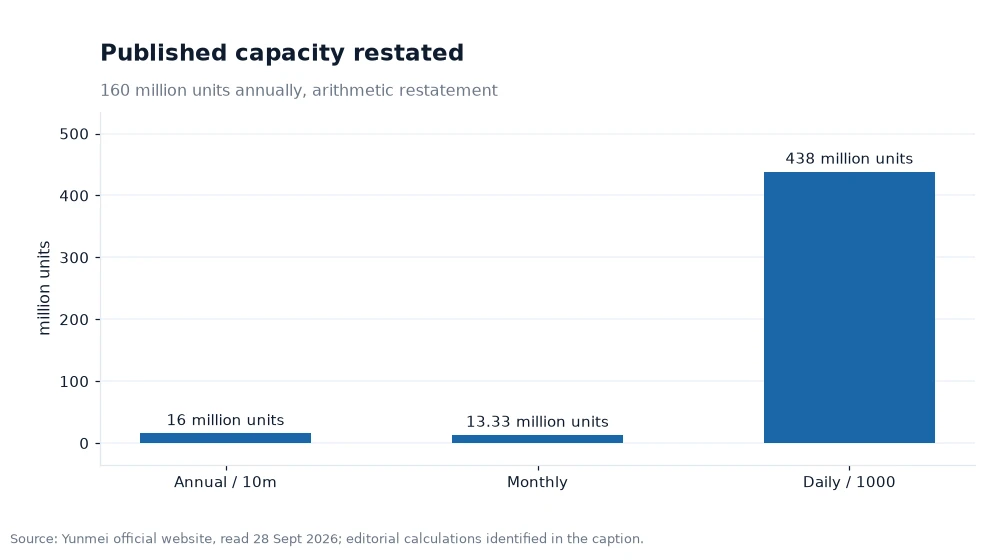
The falling bars explain the audit question. A large annual total becomes a much smaller line-level number once calendars, formats and changeovers enter the picture, so the buyer still needs a product-specific schedule.
Frequently asked questions
Should a buyer audit both factories?
Audit the site that will develop or manufacture the planned product. If work will be split across Yunmei's two factories, map the handoff and decide whether both locations need review.
Is a certificate enough evidence during an audit?
No. Facility documents provide context, but the buyer should also trace product-specific records, sample versions, materials and the controls used on the intended line.
How long should an audit action list be?
Keep it focused enough to close. Ten or fewer clearly owned actions are usually more useful than a long list that mixes serious process gaps with minor housekeeping notes.
Leave with evidence, not impressions
Photographs of equipment fade quickly as decision support. A trace exercise, change record, schedule explanation and closed action list give purchasing a defensible basis for choosing the next sample partner. An audit team should distinguish an observation from a conclusion. Write what was seen, where it occurred, which record or person confirmed it and why it matters to the planned product. Avoid labels such as 'good system' without the evidence that supports them. If a document is unavailable during the visit, record the owner and a date for follow-up instead of assuming it exists. Share factual notes with the factory contact before finalising the report so misunderstandings can be corrected. Keep commercial scoring separate from process findings: a strong price should not close a quality action, and a minor presentation issue should not be inflated into a capability failure. Clear categories make the final supplier decision fairer. Before the project is closed, compare the approved record with the exact item being purchased. Check the version, quantity, component and evidence reference rather than relying on a remembered conversation. Ask the supplier to confirm any open assumption in writing, and save that confirmation with the quotation. If an answer changes the brief, update the sample and calendar before releasing the next commitment. This final reconciliation gives the brand a clear basis for later questions from production, quality or customer service. It also makes the next order easier to plan because the team can distinguish what was learned from what was merely assumed during the first launch. Use the same disciplined approach when an audit identifies a possible gap. Confirm whether the issue is isolated or repeated, request the relevant record and ask the process owner how recurrence is prevented. A single missing signature and a missing control step are not equivalent. Give corrective actions a proportionate deadline and define what evidence closes them. If a follow-up visit is needed, state which operations will be observed and what records should be ready. A supplier that responds transparently to a clear finding may provide more useful information than a perfectly staged tour. The audit report should preserve that distinction and avoid unsupported ratings. A factual record protects both parties and lets the sourcing team explain its choice to colleagues who were not present. Review Yunmei’s OEM/ODM manufacturing overview and use the same written brief for every sample round.
Factory figures and screening ranges cited here come from Yunmei's own pages, read 28 Sept 2026; capacity restatements are calculated for context.[1].